Warp and weft are not interchangeable. They are made differently, held differently during weaving, and behave differently in the finished fabric. The choices a weaver or manufacturer makes about which yarns go in which direction — and how they interlace — determine everything from the strength and stretch of the fabric to its surface texture, drape, and pattern.
What Is the Warp?
The warp is the set of threads that runs lengthwise through a woven fabric — parallel to the selvage edges, from one end of the fabric to the other. On a loom, the warp threads are set up first, stretched taut and held under tension for the entire weaving process. They are the structural skeleton of the fabric, the framework through which the weaving is done.
Because warp threads are held under continuous tension during weaving, they need to be strong enough to withstand that stress without breaking or stretching out. This means warp yarns are typically spun tighter, made from stronger or longer fibers, and sometimes treated or sized — coated with a starch-like substance — to give them extra strength and smoothness so they can slide past each other during weaving without catching or fraying.
In the finished fabric, the warp direction is what sewists and textile workers call the straight grain or the lengthwise grain. It is the most stable direction in the fabric — the one with the least stretch — because the warp threads were under tension during weaving and retain that structural rigidity in the finished cloth.
What Is the Weft?
The weft — also called the filling in American textile terminology — is the set of threads that runs crosswise through the fabric, from one selvage edge to the other and back again. Where the warp threads are set up before weaving begins, the weft threads are inserted one by one during the weaving process, passed back and forth through the warp threads to build up the fabric row by row.
On a traditional hand loom, the weft thread is wound onto a shuttle that is passed through the warp threads by hand. On modern power looms, rapiers, projectiles, or jets of air or water carry the weft thread across the warp at high speed. Each pass of the weft thread is called a pick, and the picks are beaten down tightly together to create the fabric surface.
Because weft threads are not held under the same continuous tension as warp threads, they are generally less twisted and can be softer or more varied in character. The weft direction in the finished fabric — the crosswise grain — has slightly more give than the warp direction, because the weft threads can move a little within the weave structure.
How Warp and Weft Work Together
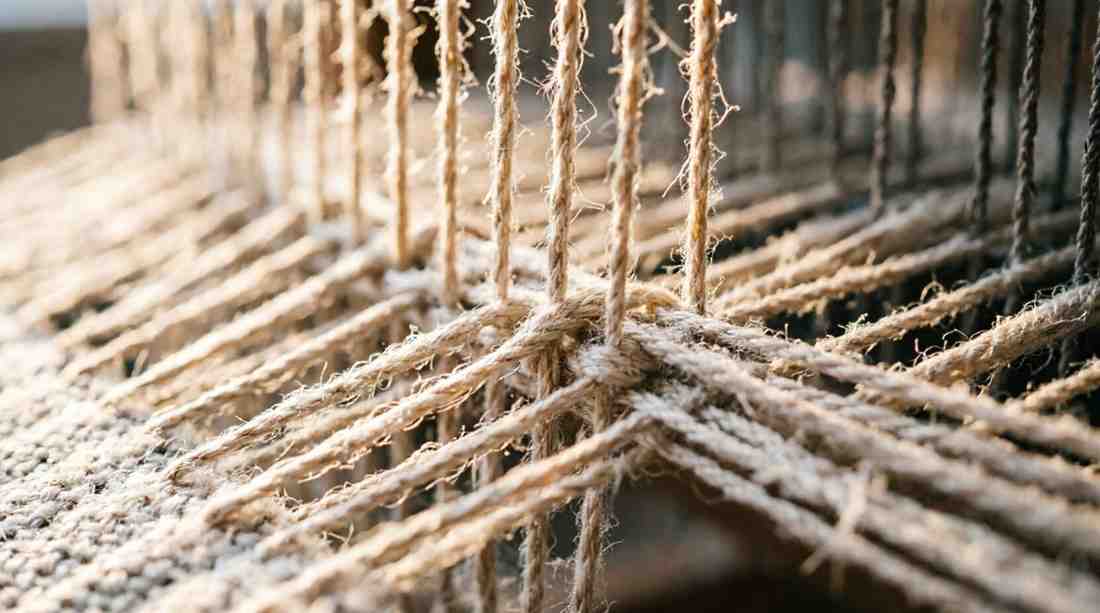
The fundamental act of weaving is the interlacing of warp and weft. The warp threads are divided into two groups — alternating threads are lifted up while the others stay down — creating a triangular opening called the shed. The weft thread is passed through the shed, crossing over the lowered warp threads and under the raised ones. Then the shed is closed, the groups of warp threads are swapped, and the next weft pick is passed through in the opposite direction. Each weft thread locks the previous one in place as the weave builds up.
The specific pattern in which warp and weft threads pass over and under each other determines the weave structure of the fabric. A plain weave interlaces every single warp and weft thread. A twill weave skips threads in a regular diagonal pattern. A satin weave allows long stretches of one thread to float over many of the other before interlacing. Each structure produces a fabric with a distinct appearance, texture, strength, and hand feel — all from the same basic principle of interlacing warp and weft.
How Warp and Weft Differ in the Finished Fabric
| Property | Warp (Lengthwise) | Weft (Crosswise) |
|---|---|---|
| Direction | Parallel to selvage | Perpendicular to selvage |
| Tension during weaving | High — held taut on loom | Low — passed through freely |
| Yarn character | Stronger, tighter twist | Often softer, less twist |
| Stretch in finished fabric | Minimal — very stable | Slight — a little give |
| Sewing term | Straight grain / lengthwise grain | Cross grain / crosswise grain |
| Garment use | Main body pieces, center front/back | Waistbands, some accent pieces |
Why the Warp Is Stronger Than the Weft
The difference in strength between warp and weft is not accidental — it is a direct result of how the two sets of threads are used during weaving. Warp threads must survive the entire weaving process under constant tension, being repeatedly separated and recombined to form the shed as thousands of weft picks are passed through. Any warp thread that breaks during weaving causes a defect in the fabric and may stop the loom entirely. So warp yarns are engineered to be strong.
Weft threads, by contrast, are simply passed through the shed. They need to be consistent in diameter and reasonably strong, but they do not face the same mechanical demands as warp threads. This is why manufacturers can use softer, lower-twist, more decorative, or more delicate yarns in the weft direction — and why many fabrics feel softer in the crosswise direction than the lengthwise one.
In denim, for example, the warp threads are traditionally dyed indigo blue while the weft threads are left white or undyed. Because the warp threads sit predominantly on the surface of the twill weave, denim looks blue — but the white weft threads become visible as the fabric wears and the indigo warp threads fade, which is what creates the characteristic worn look of broken-in denim.
Warp and Weft in Different Weave Structures
Plain weave
The simplest and most common weave structure. Every warp thread passes over one weft thread and under the next, alternating all the way across. The result is a balanced, checkerboard-like interlacing where warp and weft are equally represented on both surfaces of the fabric. Plain weave produces strong, durable fabrics with a matte, even texture. Cotton muslin, linen, and most basic shirting fabrics use plain weave.
Twill weave
In a twill weave, each warp thread passes over two or more weft threads before going under one, with each row offset by one thread to create a diagonal line on the fabric surface. This diagonal line — the twill line — is the defining visual feature of twill fabrics. Because the interlacing points are fewer and more spread out than in plain weave, twill fabrics are more flexible and have a better drape. Denim, chino, and gabardine are all twill weaves. The direction of the twill line can run left-to-right or right-to-left depending on which way the warp threads are threaded on the loom.
Satin weave
In a satin weave, the warp threads float over four or more weft threads before interlacing, creating long stretches of warp thread on the fabric surface. These long floats reflect light smoothly and evenly, which is what gives satin its characteristic sheen and silky surface. The fewer interlacing points also allow the threads to pack together more densely, producing a very smooth surface. The trade-off is that those long floating threads snag more easily than a plain or twill weave. True silk satin and polyester satin use this structure, as does cotton sateen in bedding.
What This Means for Sewing and Garment Making
For anyone who sews, the practical consequences of warp and weft run through nearly every step of the process.
- Grain alignment — Sewing patterns include a grain line arrow that should be aligned parallel to the warp — the lengthwise grain. Cutting on the correct grain ensures the garment hangs straight and the seams behave as designed.
- Seam stability — Seams sewn along the warp direction are the most stable and least likely to stretch out over time. Side seams, center front seams, and center back seams typically run along the warp.
- Hem behavior — A hem cut on the cross grain has a slight natural give that allows it to curve around the body. A hem cut on the bias has the most stretch and drape.
- Pattern matching — Stripes and plaids woven into the fabric run along the warp and weft directions. Understanding those directions makes it much easier to match patterns at the seams accurately.
- Pressing and shaping — Steam pressing can temporarily stretch fabric slightly along the cross grain but has very little effect on the warp direction. Tailors use this difference deliberately when shaping curved seams and collars.
Warp and Weft Beyond Clothing
The same warp and weft principles that apply to clothing fabric apply across the entire world of woven textiles. In hand weaving and tapestry, artists make deliberate choices about which yarns go in which direction to control where color and texture appear on the surface. In technical and industrial textiles, the orientation of warp and weft threads relative to anticipated stress directions determines the strength and failure characteristics of everything from seat belts to medical bandages to architectural mesh. In carpet weaving, the warp provides structural support while the weft creates the pile surface pattern.
Even in everyday products you might not think of as woven — denim, canvas tote bags, linen napkins, cotton bandanas — the behavior of warp and weft threads is quietly determining how the product stretches, wears, fades, and ages.
Frequently Asked Questions
How do I tell which direction is the warp and which is the weft in a piece of fabric?
The warp runs parallel to the selvage — the finished edge along the long sides of the fabric as it comes off the bolt. If you can identify the selvage, you have identified the warp direction. If you cannot see the selvage, pull the fabric gently in both directions — the warp direction will have less stretch than the weft direction.
Does it matter which direction I cut fabric if I am not sewing?
For most practical cutting tasks — making cleaning rags, cutting fabric for crafts, trimming a length for a tablecloth — grain direction has little consequence. For any project where the fabric needs to hang straight, fit the body, or hold its shape over time, cutting on the correct grain matters significantly.
Why does fabric fray more on some edges than others?
Cut edges perpendicular to the warp — crosswise cuts — tend to fray more readily than cuts parallel to the warp. This is because the weft threads at a crosswise cut edge have nothing holding them in at the end and pull out easily. The selvage edge, which runs along the warp, does not fray at all because it is a finished woven edge. This is why fabric care instructions often suggest finishing raw edges before washing.
What is a balanced weave?
A balanced weave is one where the warp and weft threads are of similar weight and similar density — roughly the same number of threads per inch in both directions. Plain weave cotton muslin is a classic example. An unbalanced weave uses different weights or densities in the warp and weft directions, which produces fabrics with distinctly different properties in different directions — like ribbed fabrics where the weft threads are much thicker than the warp.
Is warp or weft more important?
Neither is more important than the other — they are interdependent. Without the warp, there is no framework to weave through. Without the weft, there is no fabric. What matters is how the two interact, and the choices made about yarn type, weight, and interlacing pattern in each direction determine the character of the finished fabric.
The Bottom Line
Warp and weft are the two fundamental building blocks of all woven fabric. The warp runs lengthwise, is held under tension during weaving, and produces the strong, stable direction of the finished cloth. The weft runs crosswise, is passed through the warp during weaving, and produces the slightly more flexible cross-grain direction. Every woven fabric is a product of how these two thread directions interact — in what pattern, with what yarns, at what density.
You do not need to think about warp and weft every time you touch a piece of fabric. But when a garment twists, a seam stretches, or a fabric drapes differently than expected, the answer almost always comes back to these two thread directions and the relationship between them. Understanding warp and weft does not just explain how fabric is made — it explains why fabric behaves the way it does, stitch by stitch and wash by wash.