Nonwoven fabric is one of the fastest-growing segments of the entire textile industry, and for good reason — it can be engineered for specific performance properties, produced at very high speed, and manufactured at a cost that woven fabric often cannot match for disposable or single-use applications. Understanding what nonwovens are, how they are made, and where they show up in everyday life gives you a more complete picture of the textile world than woven fabrics alone can provide.
What Is Nonwoven Fabric?
A nonwoven fabric is a sheet or web of fibers bonded together by mechanical, thermal, or chemical means — without weaving, knitting, or any other process that creates an interlaced thread structure. Instead of being built from yarn, nonwoven fabrics are built directly from fibers — either staple fibers laid into a web or continuous filaments extruded and deposited directly onto a moving belt.
The key difference from woven fabric is structural. Woven and knitted fabrics have a defined, repeating thread structure — warp and weft interlacing, or loops interlocking — that gives them their characteristic properties. Nonwoven fabrics have a random or semi-random fiber arrangement that is held together by entanglement, adhesion, or fusion rather than interlacing. This gives nonwovens a distinct set of properties — they do not ravel or fray at cut edges, they can be made isotropic (behaving the same in all directions), and they can be engineered with precision for specific applications.
How Nonwoven Fabric Is Made
There is not one single process for making nonwoven fabric — there are several, and each produces a material with different characteristics. The choice of manufacturing method depends on the fiber type, the intended end use, and the performance properties required.
Needlepunching
One of the oldest nonwoven manufacturing methods. A web of loose fibers — typically wool, polyester, or a blend — is fed through a machine fitted with hundreds of barbed needles that punch repeatedly through the web. As the needles penetrate and withdraw, the barbs catch and drag fibers through the web, mechanically entangling them with each other. The more passes through the needling machine, the denser and more tightly bonded the resulting fabric. Needlepunched nonwovens are used for carpet backing, geotextiles, industrial filtration, and some types of felt. The process produces a sturdy, dimensionally stable material with no thread structure to unravel.
Hydroentanglement — spunlace
Instead of needles, hydroentangled nonwovens use high-pressure jets of water to entangle the fibers. A thin web of fibers is placed on a moving belt and subjected to multiple rows of extremely fine, high-velocity water jets. The water jets push individual fibers through the web and tangle them around each other, bonding the web without any adhesives or heat. The result is a soft, drapeable, cloth-like material — much more textile-like in feel than needlepunched fabric. Hydroentangled nonwovens are used for baby wipes, facial cleansing wipes, medical dressings, and some synthetic suede-like materials. The soft hand feel of these products comes directly from the gentleness of the water entanglement process compared to needle punching.
Spunbonding
Spunbond nonwovens are made by extruding continuous filament fibers — typically polypropylene or polyester — directly onto a moving belt in a random pattern, then bonding them together with heat and pressure. Because the fibers are continuous filaments rather than staple fibers, spunbond nonwovens are very strong relative to their weight. The tote bags distributed at grocery stores, the reusable shopping bags made from that papery-feeling polypropylene fabric, and the outer layers of many disposable diapers are all spunbond nonwovens. The process is extremely fast and economical, which makes spunbond materials suitable for high-volume applications.
Meltblown
Meltblown is similar to spunbonding but uses high-velocity hot air to blow the extruded polymer into extremely fine fibers — sometimes as fine as one micron in diameter — that are deposited in a random mat. The resulting fabric has very fine, densely packed fibers that create an effective barrier to particles, droplets, and aerosols. Meltblown fabric became widely known during the COVID-19 pandemic as the filtration layer in N95 and surgical masks. It is also used in filtration systems, oil-absorbent materials, and as insulation in some specialty applications. Meltblown fabric by itself is relatively fragile — it is typically sandwiched between spunbond layers to create a stronger composite structure, which is the SMS (spunbond-meltblown-spunbond) construction used in most high-performance masks and medical protective equipment.
Chemical and thermal bonding
Some nonwovens are bonded by applying an adhesive binder to a fiber web and curing it with heat, or by incorporating thermoplastic fibers into the web that melt and fuse at specific points when heated. Chemically bonded nonwovens are used for some types of interfacing, disposable wipes, and industrial materials. Thermally bonded nonwovens — also called heat-bonded — are used for quilt batting, some types of interlining, and lightweight disposable materials where softness is more important than strength.
Common Types of Nonwoven Fabric
Felt
Felt is the oldest nonwoven fabric in human history — predating woven cloth by thousands of years. Traditional felt is made from wool fibers that are subjected to heat, moisture, and mechanical agitation. Wool fibers have a microscopic surface structure of overlapping scales, and under the right conditions those scales interlock with each other and cannot be separated — a process called felting. The result is a dense, matted fabric with no thread structure, remarkable dimensional stability, and a characteristic soft, slightly rough surface.
Modern craft felt sold in fabric stores is usually made from acrylic fibers rather than wool, bonded by needlepunching rather than traditional wet felting. It is cheaper, available in a wide range of colors, and does not shrink or felt further when washed. Wool felt used in industrial applications — piano hammer felt, acoustic panels, protective padding — is still made using traditional felting processes because wool's natural felting ability produces a density and resilience that synthetic needlepunched felt cannot fully replicate.
Interfacing
Interfacing is one of the most important nonwoven fabrics in garment construction, and one of the least visible. It is a stiffening fabric applied to the wrong side of garment pieces — collars, cuffs, waistbands, button plackets, and necklines — to give them structure, body, and stability. Without interfacing, a shirt collar would collapse and wilt. A jacket lapel would flop rather than roll cleanly. A waistband would stretch out of shape and bunch.
Fusible interfacing — by far the most common type — has a heat-activated adhesive coating on one side. When pressed with an iron, the adhesive melts and bonds the interfacing to the fashion fabric permanently. Sew-in interfacing has no adhesive and is stitched to the fabric instead, which makes it suitable for delicate fabrics that cannot withstand the heat and pressure of fusing. Interfacing comes in a range of weights — from very lightweight for sheer fabrics to heavy and stiff for structured tailoring — and in woven, knit, and nonwoven constructions. Nonwoven interfacing is the most widely used because it is inexpensive, easy to apply, and does not add any grain direction of its own to the garment piece.
Batting and wadding
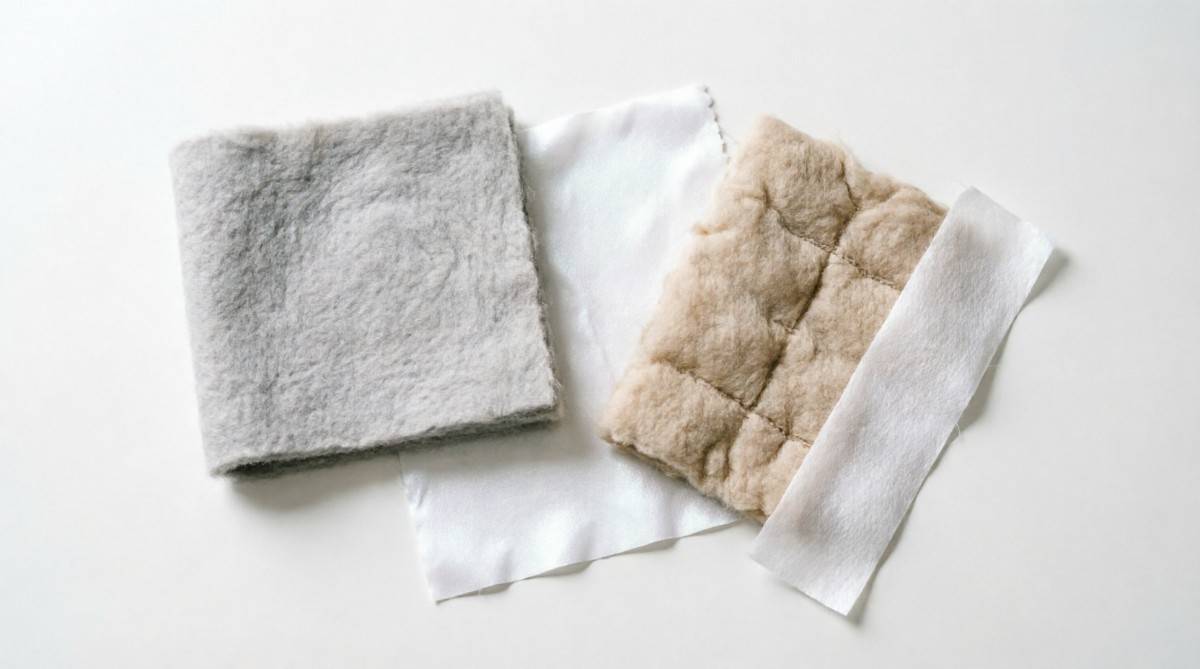
Quilt batting — called wadding in the United Kingdom — is a thick, lofty nonwoven material used as the middle layer in quilts, comforters, and padded garments to provide warmth and loft. It is typically made from polyester, cotton, wool, or blends, in a needlepunched or thermally bonded construction that holds the fibers in a stable, even layer without compressing them. Polyester batting is the most common — it is resilient, washable, hypoallergenic, and inexpensive. Cotton batting has better breathability and a flatter, more antique look after washing. Wool batting has excellent temperature regulation but is more expensive and requires more careful care.
Medical and hygiene nonwovens
The medical industry is one of the largest users of nonwoven fabric in the world. Surgical gowns, drapes, caps, and shoe covers are almost all made from spunbond or SMS nonwovens — disposable after a single use, which eliminates the risk of cross-contamination that reusable woven textiles carry if not properly sterilized. Wound dressings, gauze pads, and bandaging materials are often hydroentangled or chemically bonded nonwovens. Disposable diapers use multiple layers of nonwoven fabric — a soft spunlace layer against the skin, absorbent layers in the core, and a liquid-resistant spunbond outer layer.
Geotextiles and industrial nonwovens
Some of the largest-volume nonwoven fabrics never appear in clothing or home goods at all. Geotextiles are heavy needlepunched or woven nonwovens used in civil engineering — laid under roads, beneath landscaping, along retaining walls, and in drainage systems to stabilize soil, filter water, and separate different types of aggregate. Filtration nonwovens are used in air filters, water treatment systems, and industrial dust collection. Automotive nonwovens are used in car interiors — door panels, trunk liners, headliners, and underbody insulation are all nonwoven materials engineered for weight, acoustic performance, and durability.
| Nonwoven Type | Manufacturing Method | Key Properties | Common Uses |
|---|---|---|---|
| Wool felt | Wet felting — heat, moisture, agitation | Dense, stable, soft, no fray | Crafts, piano hammers, acoustic panels |
| Acrylic felt | Needlepunching | Colorful, inexpensive, washable | Craft projects, decorations |
| Fusible interfacing | Chemical or thermal bonding | Structured, adhesive backing | Collar, cuffs, waistbands, plackets |
| Quilt batting | Needlepunch or thermal bond | Lofty, lightweight, insulating | Quilts, comforters, padded garments |
| Spunbond | Continuous filament extrusion | Strong, lightweight, economical | Reusable bags, diaper outer layers |
| Meltblown | High-velocity air extrusion | Ultra-fine fibers, excellent filtration | N95 masks, air filters, medical barriers |
| Spunlace / hydroentangled | High-pressure water jets | Soft, drapeable, cloth-like | Wipes, facial pads, medical dressings |
| Geotextile | Heavy needlepunching | Strong, durable, permeable | Road construction, landscaping, drainage |
Nonwoven vs Woven — Key Differences
The differences between nonwoven and woven fabric run deeper than just the manufacturing process. They behave differently, perform differently, and are suited to different applications for structural reasons.
- Fraying — Woven fabrics fray at cut edges because the interlaced threads can unravel. Nonwoven fabrics do not fray because there are no interlaced threads to unravel — the fibers are bonded throughout the material. This makes nonwovens useful wherever cut edges will be exposed without finishing.
- Directionality — Woven fabrics have a defined grain — they behave differently in the lengthwise, crosswise, and bias directions. Most nonwovens are isotropic or near-isotropic — they behave similarly in all directions — which makes them simpler to work with in some applications.
- Drape and flexibility — Most nonwovens are stiffer and less drapeable than woven fabrics of similar weight, because bonded fibers cannot slide past each other the way interlaced threads can. Hydroentangled nonwovens are the exception — they have a soft, cloth-like drape that approaches woven fabric quality.
- Durability — Woven fabrics are generally more durable and washable than most nonwovens, because the interlaced thread structure distributes stress effectively. Many nonwovens are designed for limited or single-use applications rather than long-term durability.
- Cost and speed — Nonwovens can be produced much faster and more cheaply than woven fabrics for many applications, which is why they dominate disposable and high-volume industrial markets.
Frequently Asked Questions
Is felt a nonwoven fabric?
Yes — felt is one of the oldest and best-known nonwoven fabrics. It is made by bonding fibers together through felting (for wool) or needlepunching (for synthetic felt) rather than weaving or knitting. The absence of any thread structure is why felt does not fray at cut edges and why it behaves so differently from woven wool fabric made from the same fiber.
What is the difference between woven and nonwoven interfacing?
Woven interfacing has a grain direction like any woven fabric and must be cut on the same grain as the fashion fabric it will be applied to. It is more stable along the grain and more flexible on the bias. Nonwoven interfacing has no grain direction and can be cut in any direction without affecting its behavior — which makes it easier to use and more economical because there is less waste when cutting pattern pieces. For most home sewing applications, nonwoven fusible interfacing is the practical default.
Are disposable masks made from nonwoven fabric?
Yes. Most disposable surgical and procedure masks use two or three layers of nonwoven fabric — typically spunbond outer layers for structure and fluid resistance, and a meltblown middle layer for particle filtration. N95 respirators use a similar construction with a denser, more electrostatically charged meltblown layer that captures very fine particles. The nonwoven construction is what allows these masks to be produced quickly and inexpensively at the volumes required for medical and public health use.
Can nonwoven fabric be washed and reused?
It depends entirely on the type and construction. Wool felt and high-quality needlepunched nonwovens can be washed carefully, though most will shrink or distort with repeated washing. Craft acrylic felt is washable but may pill. Most spunbond polypropylene nonwovens — like reusable grocery bags — are washable. Disposable nonwovens like surgical masks, wipes, and paper towels are designed for single use and will fall apart when wet or washed. Fusible interfacing, once bonded to fabric, is as washable as the fashion fabric it is attached to.
What makes nonwoven fabric suitable for filtration?
The random fiber arrangement in nonwoven fabric — especially in meltblown and needlepunched constructions — creates a tortuous path that particles must navigate to pass through the material. Fine particles get caught on fibers and cannot easily pass around them. The finer the fibers and the denser the web, the more effective the filtration. Electrostatic charge added to meltblown nonwovens attracts and holds particles even more effectively, which is why electrostatically charged meltblown is the standard filtration layer in N95 masks.
The Bottom Line
Nonwoven fabric is not a niche or secondary category of textiles — it is a massive, versatile class of materials that surrounds us in everyday life, from the interfacing in a shirt collar to the filtration layer in an air purifier to the geotextile fabric under a highway. What makes nonwovens distinct is not just that they are made without weaving, but that they can be engineered with precision for specific performance requirements — filtration efficiency, softness, barrier properties, strength, or absorbency — in ways that woven fabrics often cannot match.
For sewists and garment makers, the most relevant nonwovens are felt, interfacing, and batting — all of which play structural or decorative roles in finished projects. For everyone else, understanding nonwovens means recognizing that a huge proportion of the fabric-like materials you interact with every day were made through a fundamentally different process than the weaving and knitting that most people associate with textiles. The technology is less visible than a beautifully woven silk, but it is everywhere.