Care labels exist for a specific reason: the manufacturer knows exactly what the fabric is, how it was constructed, and what it can and cannot survive. Following the label is not overcaution — it is the fastest way to keep a garment looking the way it looked when you bought it. This guide decodes the entire care label system — every symbol category, every variation, and what each combination tells you about how to treat your clothes.
How the Care Label System Works
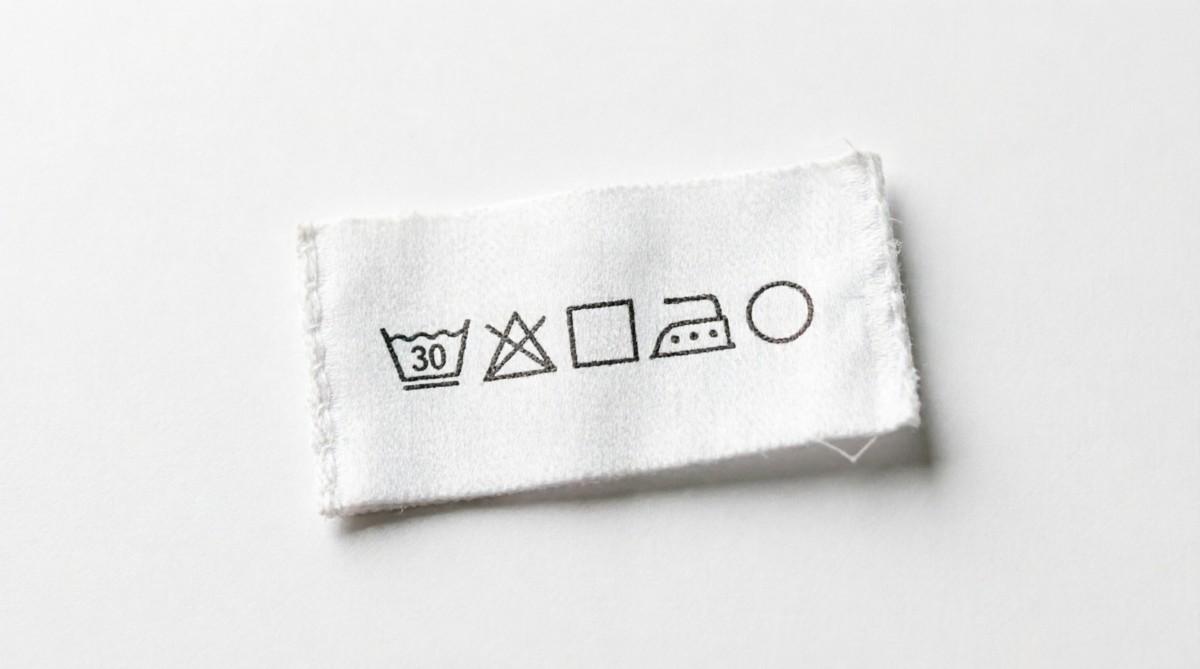
The international care labeling system uses five basic symbols, each representing a different care process. Every symbol has a base shape that identifies the process, and modifications to that shape — dots inside, lines underneath, an X through the symbol — specify the temperature or intensity, or prohibit the process entirely.
The five base symbols are a washtub for washing, a triangle for bleaching, a square for drying, an iron shape for ironing, and a circle for dry cleaning or professional care. In the United States, garments sold since 1971 are required by the Federal Trade Commission to have a permanent care label. Most US labels now use the international ASTM symbols, though some older garments and some imports use written instructions instead of or alongside the symbols.
The logic of the modification system is consistent across all five categories. Dots inside a symbol indicate temperature — more dots mean more heat. Lines underneath a symbol indicate a gentler treatment than the base symbol. An X through any symbol means do not perform that process at all. Once you understand this underlying logic, the entire system becomes much easier to read.
The Washing Symbol — The Washtub
The washing symbol is a simple outline of a washtub or bucket shape with a wavy line of water inside. It tells you whether the garment can be machine washed, should be hand washed, or must not be washed with water at all. The dots inside the tub indicate water temperature, and lines underneath indicate a gentler machine cycle.
| Symbol Description | What It Means |
|---|---|
| Washtub — no dots | Machine wash, any temperature |
| Washtub — one dot | Machine wash, cold water only (up to 85°F / 30°C) |
| Washtub — two dots | Machine wash, warm water (up to 105°F / 40°C) |
| Washtub — three dots | Machine wash, hot water (up to 120°F / 50°C) |
| Washtub — four dots | Machine wash, very hot water (up to 140°F / 60°C) |
| Washtub — one line underneath | Machine wash on permanent press / medium cycle |
| Washtub — two lines underneath | Machine wash on gentle or delicate cycle |
| Hand in washtub | Hand wash only — do not machine wash |
| Washtub with X through it | Do not wash with water — dry clean only |
What the washing temperature actually means
Cold water washing — one dot — is the recommended setting for dark colors that may bleed, delicate fabrics, lightly soiled items, and anything where you want to preserve the garment's shape and color over time. It is also the most energy-efficient wash setting. Warm water — two dots — is the everyday standard for most cotton and synthetic blend garments that need a thorough clean. Hot water — three or four dots — is reserved for heavily soiled items, white cotton that needs deep cleaning, and bedding or towels where sanitization matters. Using hotter water than the label specifies risks shrinkage, color bleeding, and fiber damage.
The Bleaching Symbol — The Triangle
The bleaching symbol is a triangle — like an upside-down yield sign. It tells you whether and how you can use bleach on the garment. Bleach is powerful enough to destroy certain fibers and strip color from dyed fabric if used incorrectly, so this symbol is worth paying close attention to.
| Symbol Description | What It Means |
|---|---|
| Empty triangle | Any bleach may be used when needed |
| Triangle with two diagonal lines inside | Only non-chlorine (oxygen / color-safe) bleach permitted |
| Triangle with X through it | Do not bleach under any circumstances |
Chlorine bleach vs oxygen bleach
Chlorine bleach — the standard liquid bleach like Clorox — is a harsh chemical oxidizer that whitens and sanitizes effectively but can permanently damage wool, silk, spandex, and many synthetic fibers, and will strip color from dyed fabric. The triangle with two diagonal lines means only the gentler oxygen-based bleaches — sold as color-safe bleach or OxiClean-style products — are safe to use. These are significantly milder and safe for colored fabrics and most fiber types. A crossed triangle means the fabric cannot handle any bleach treatment — typically because the fiber itself would be damaged, not just the color.
The Drying Symbol — The Square
The drying symbol is a square, and it comes in two important variations: a square with a circle inside it for tumble drying, and a plain square with lines for flat or hang drying. This symbol category is one of the most important on the label — incorrect drying causes more irreversible damage to garments than almost any other care mistake.
| Symbol Description | What It Means |
|---|---|
| Square with circle inside — no dots | Tumble dry, any heat |
| Square with circle — one dot | Tumble dry, low heat |
| Square with circle — two dots | Tumble dry, medium heat |
| Square with circle — three dots | Tumble dry, high heat |
| Square with circle — one line underneath | Tumble dry on permanent press setting |
| Square with circle — two lines underneath | Tumble dry on gentle or delicate setting |
| Square with circle and X through it | Do not tumble dry |
| Square with single horizontal line through middle | Dry flat — lay horizontally to dry |
| Square with curved line at top | Hang to dry — drip dry on hanger |
| Square with three vertical lines inside | Drip dry — hang while wet without wringing |
| Square with diagonal lines in corner | Dry in shade — away from direct sunlight |
Why drying method matters so much
The combination of heat and mechanical tumbling in a dryer is significantly more aggressive than any washing cycle. Wool shrinks dramatically in a dryer because the heat and agitation cause the fiber scales to interlock — a process that is essentially irreversible. Silk can lose its luster and become stiff. Bras and structured garments lose their shape. Elastic and spandex degrade faster under repeated dryer heat. Many garments that survive machine washing in perfect condition are destroyed in a single dryer cycle. When a label says do not tumble dry, it means exactly that.
The Ironing Symbol — The Iron
The ironing symbol is a simple outline of a clothes iron viewed from the side. Dots inside the iron indicate temperature — exactly the same dot system used for washing — and an X means do not iron.
| Symbol Description | What It Means | Fiber Types |
|---|---|---|
| Iron — one dot | Low heat iron (up to 230°F / 110°C) | Synthetic fibers — polyester, nylon, acrylic |
| Iron — two dots | Medium heat iron (up to 300°F / 150°C) | Wool, silk, polyester blends |
| Iron — three dots | High heat iron (up to 390°F / 200°C) | Cotton, linen |
| Iron with lines underneath | Iron with steam | Varies by fiber |
| Iron with X through steam lines | Do not use steam — dry iron only | Velvet, some embellishments |
| Iron with X through it | Do not iron | Delicate embellishments, certain finishes |
Why ironing temperature matters by fiber
Synthetic fibers melt — they do not burn or scorch the way natural fibers do, they melt — and the melting point of polyester is well within the range of a medium or high heat iron. A single pass of a too-hot iron over polyester leaves a permanent shiny scorch mark or causes the fabric to warp and distort that cannot be undone. Cotton and linen, by contrast, actually need high heat to release wrinkles effectively — a low-temperature iron barely makes a dent. Silk is heat-sensitive and should be ironed on the reverse side with a pressing cloth at medium heat. Wool should be pressed with steam rather than direct contact to avoid crushing the fiber.
The Dry Cleaning Symbol — The Circle
A plain circle means the garment can be dry cleaned. Letters inside the circle are instructions for the professional dry cleaner about which cleaning solvent to use — information relevant to the cleaner rather than to you at home. A circle with an X through it is one of the most important symbols on any label — it means do not dry clean, which is unusual and worth noting since most garments can safely be dry cleaned.
| Symbol Description | What It Means |
|---|---|
| Plain circle | Dry clean — any solvent |
| Circle with letter A | Dry clean with any solvent |
| Circle with letter P | Dry clean — any solvent except trichloroethylene |
| Circle with letter F | Dry clean with petroleum-based solvent only |
| Circle with letter W | Wet clean — professional wet cleaning only |
| Circle with one line underneath | Dry clean on gentle cycle |
| Circle with X through it | Do not dry clean |
Reading a Complete Label — Putting It Together
A care label typically shows all five symbols in a row, reading left to right: wash, bleach, dry, iron, dry clean. Once you know each symbol individually, reading the complete label takes only a few seconds. Here are some common label combinations decoded.
The everyday cotton t-shirt label
Washtub with two dots (machine wash warm) — crossed triangle (do not bleach) — square with circle and two dots (tumble dry medium) — iron with two dots (medium iron) — circle with X (do not dry clean). Translation: wash in warm water, no bleach, medium heat dryer, medium iron if needed, wash at home rather than dry cleaning.
The wool sweater label
Hand in washtub (hand wash only) — crossed triangle (do not bleach) — square with horizontal line (dry flat) — iron with two dots and steam (medium steam iron) — plain circle (dry clean acceptable). Translation: hand wash in cool water or dry clean, never tumble dry, always lay flat to dry, press gently with steam if needed.
The silk blouse label
Washtub with one dot and two lines (machine wash cold, delicate cycle) or hand in washtub — crossed triangle — square with circle and X (do not tumble dry) — iron with one or two dots (low to medium iron only) — plain circle (dry clean acceptable). Translation: gentle cold wash or hand wash, air dry only, cool iron on reverse side, dry cleaning is a safe option.
The performance synthetic activewear label
Washtub with one dot (machine wash cold) — crossed triangle (no bleach) — square with circle and one dot (tumble dry low) — iron with X (do not iron) — circle with X (do not dry clean). Translation: cold machine wash, low heat dryer is fine, never iron, wash at home only.
What Happens When You Ignore the Label
Care labels are not suggestions — they are the manufacturer's warranty on the garment's survival. Ignoring them has predictable consequences that vary by fiber and process.
- Wool washed hot or tumble dried — Irreversible felting and shrinkage. The fiber scales interlock permanently. A large sweater becomes a child-sized one in a single cycle and cannot be restored.
- Silk machine washed or tumble dried — Loss of luster, permanent stiffness, potential fiber damage and deterioration over time. Silk's protein structure weakens with harsh agitation and heat.
- Polyester ironed on high heat — Permanent shiny scorch marks or fabric distortion from melting. Cannot be reversed.
- Delicate garments machine washed on normal cycle — Snags, pulls, distortion, broken embellishments, stretched-out elastic, and permanent shape loss from excessive agitation.
- Chlorine bleach on colored or delicate fabric — Immediate and permanent color stripping or fiber damage. Some fibers dissolve or weaken structurally on contact with chlorine bleach.
Frequently Asked Questions
What does it mean when a label just says dry clean only — is it really necessary?
Not always — but sometimes absolutely yes. Dry clean only labels on structured garments like suits and tailored jackets are genuinely important because the construction — canvas interlining, pad stitching, precise shaping — cannot survive water washing without distortion. For simpler garments labeled dry clean only, it often means the fabric is delicate enough that the manufacturer is not willing to guarantee results from home washing. Many such garments can be carefully hand washed in cold water, but you are taking a risk that the manufacturer will not stand behind.
What does the P in a circle on a dry cleaning label mean?
The letter P inside the circle is an instruction to the dry cleaner, not to you. It means the garment can be dry cleaned with any solvent except trichloroethylene — a specific cleaning chemical that can damage certain fibers and dyes. Your dry cleaner will know what this means. You simply bring the garment in and point out the label if you want to be thorough.
Can I wash something labeled hand wash only in a machine on the delicate cycle?
Sometimes — but with real risk. A delicate machine cycle with a mesh laundry bag approximates the gentleness of hand washing reasonably well for many fabrics. For wool, cashmere, and silk, even a delicate machine cycle introduces more agitation than hand washing and increases the risk of shrinkage, felting, or fiber damage. For sturdier fabrics labeled hand wash out of general caution rather than fiber fragility, a delicate machine cycle is often fine in practice.
My label has symbols I do not recognize — where can I look them up?
The ASTM International care labeling standard and the ISO care labeling standard both have complete symbol reference charts available online. The American Cleaning Institute also maintains a free, comprehensive care symbol guide at their website. Searching for ASTM care label symbols or ISO 3758 laundry symbols will bring up authoritative, complete references.
Does the order of symbols on the label matter?
Yes — the standard order is always wash, bleach, dry, iron, professional textile care (dry cleaning or wet cleaning), reading left to right. This consistent order means you always know which symbol refers to which process without needing to interpret context. Some labels abbreviate and only show the most critical instructions — particularly prohibitions — rather than the complete five-symbol set.
The Bottom Line
Care labels are a direct line of communication from the people who made your garment to you — telling you exactly what the fabric can handle and what will damage it. The symbol system is logical, consistent, and readable once you understand the five base shapes and the modification rules: dots mean temperature, lines mean gentler treatment, and an X means do not do this.
The investment of two minutes to read and understand a care label before washing a new garment is one of the highest-return habits in clothing care. Most garment damage — shrunken wool, melted polyester, faded colors, distorted silk — is entirely preventable. The label told you how to avoid it. Following the label is not caution for its own sake — it is the straightforward path to keeping your clothes in the condition you paid for them to be in.